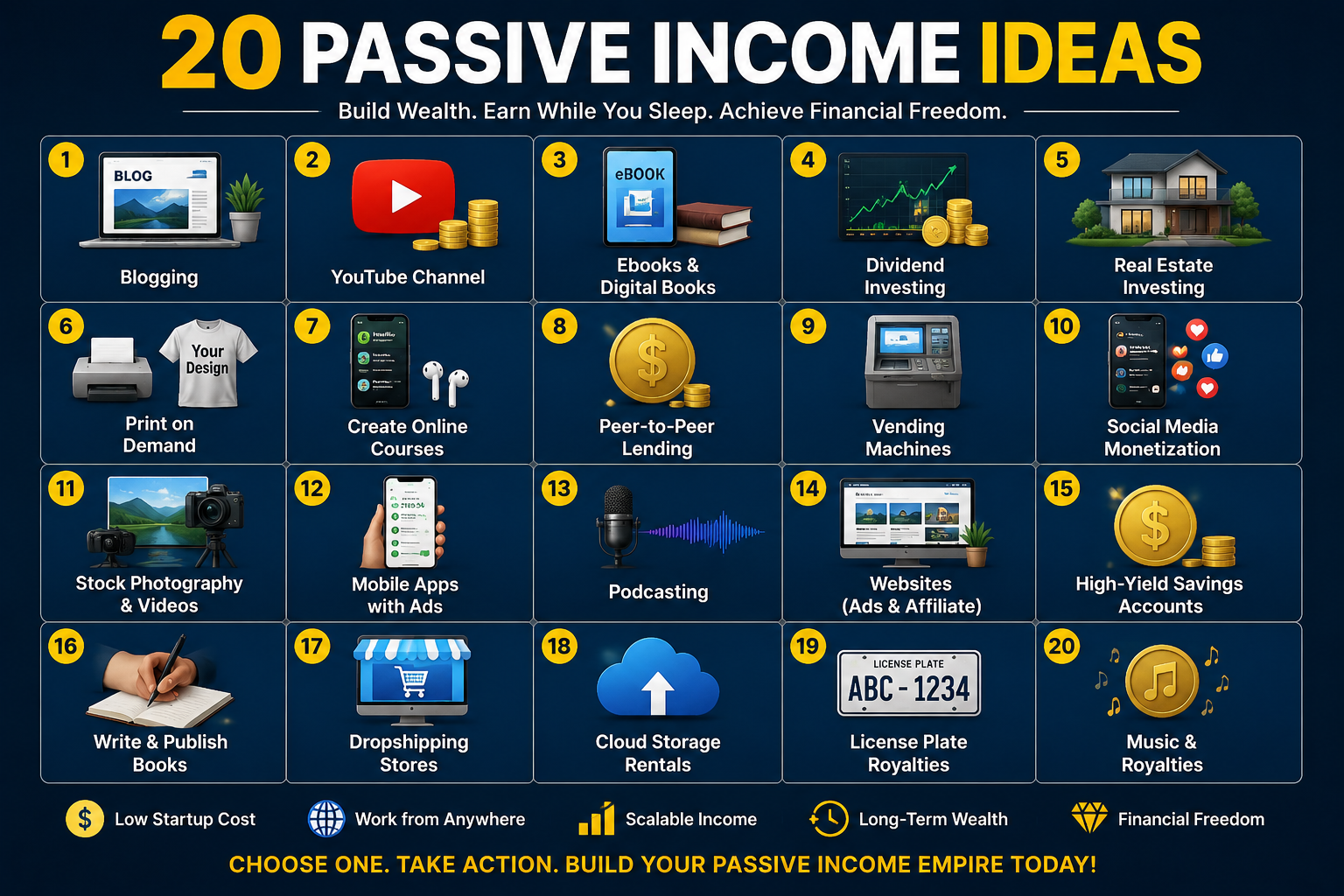
Passive Income Explained: Online Business Models, Realistic Expectations, and How to Get Started
Passive income is often described as money earned with little or no ongoing work. While the idea sounds attractive, the reality is more complicated. Most income-producing assets require time, knowledge, planning, maintenance, or an initial financial investment before they can become useful.
For example, a digital template can be sold to multiple customers after it has been created. However, its creator may still need to improve the template, answer questions, promote it, and resolve technical problems. Similarly, a website can attract visitors long after an article is published, but its content may need updates to remain accurate and relevant.
Understanding these responsibilities is important before choosing an online business model.
This guide explains what passive income means, how it differs from active income, which online models are available, what ongoing work they require, and how beginners can evaluate opportunities before investing their time or money.
What Is Passive Income?
Passive income generally refers to earnings generated through an asset, investment, or system that does not require the same amount of active work for every transaction.
Unlike traditional employment or hourly freelancing, some income-producing assets can continue delivering value after the initial work has been completed.
Consider these examples:
- Active income: A freelance designer creates a logo for a client and receives payment for that project.
- Semi-passive income: A designer creates a reusable presentation template and makes it available to multiple buyers.
- Automated delivery: An online store automatically delivers a purchased digital file to a customer.
Each model involves different responsibilities. The designer still needs to find customers, maintain the product, and manage business expenses.
Therefore, passive income is better understood as a way to reduce repeated work rather than a promise of earning money without effort.
Why Passive Income Requires Realistic Expectations
Online discussions sometimes focus on the potential earnings of a business without explaining the work behind them. This can create unrealistic expectations, particularly for beginners.
A website may need months of consistent publishing and improvement before attracting a meaningful audience. A digital product may receive little interest until its creator understands what potential customers actually need. A software tool may require regular testing and technical support.
There are also uncertainties that cannot be completely controlled. Search engine rankings can change, customers may lose interest, advertising rates may fluctuate, and competitors may introduce better alternatives.
Before starting any income-producing project, consider three questions:
- What specific problem will the product or service solve?
- What resources will be required to create and maintain it?
- How will its usefulness and performance be evaluated?
These questions help turn a general interest in passive income into a practical business decision.
Active, Semi-Passive, and Automated Income Compared
Understanding the differences between income models makes it easier to choose one that fits your circumstances.
| Model | How it works | Ongoing responsibility |
|---|---|---|
| Freelancing | Payment for a specific service | Finding clients and completing work |
| Digital products | Reusable resources sold to customers | Updates, support, and marketing |
| Content websites | Content attracts visitors and may generate revenue | Publishing, maintenance, and audience development |
| Online courses | Educational materials are offered to learners | Content updates and learner support |
| Software tools | Applications solve recurring problems | Development, hosting, security, and support |
| Automated online stores | Software handles some sales processes | Inventory, suppliers, customer service, and monitoring |
These categories are not fixed. A digital product business may initially require substantial active work but become easier to manage after its processes improve. A seemingly automated business may become more demanding as its customer base grows.
The most suitable option depends on your skills, available resources, and willingness to maintain the business.
1. Digital Products
Digital products are resources delivered electronically rather than as physical goods. They can include ebooks, spreadsheets, templates, printable planners, design assets, educational guides, and downloadable business resources.
Their main advantage is reusability. A creator can develop a resource once and potentially distribute copies to many customers without manufacturing a new physical item for each sale.
However, creating a file is not the same as creating a product people want to use.
How to develop a useful digital product
Start by identifying a specific problem.
For example, a person who understands spreadsheets might create a simple expense-tracking template for small businesses. Someone with experience organising projects might develop a task-planning resource for students or freelancers.
Before investing substantial time, investigate whether the intended audience experiences the problem and whether existing resources already address it.
A practical development process includes:
- Identify a clearly defined audience.
- Research the audience’s needs and common difficulties.
- Create a small, usable first version.
- Ask potential users for feedback.
- Improve the product based on actual problems.
- Explain what the product includes and what it does not do.
- Establish a process for delivery, support, and updates.
What maintenance involves
Digital products can become outdated, contain errors, or require improvements. Customers may also need instructions or assistance.
Creators should account for these responsibilities when deciding whether the product is worth developing.
2. Affiliate Marketing
Affiliate marketing allows publishers to earn commissions by referring customers to another company’s products or services through tracked links.
For example, an educational website might publish a comparison of website-building tools. If a reader follows an affiliate link and completes an eligible purchase, the publisher may receive a commission under the programme’s terms.
However, commissions are not guaranteed. Earnings depend on factors such as audience interest, purchasing decisions, programme rules, and the continued availability of the products being recommended.
How to create useful affiliate content
An article should help readers understand a product rather than simply encourage them to buy it.
Useful information may include:
- The product’s main features
- Practical benefits and limitations
- Relevant pricing information, where verified
- The types of users it may suit
- Situations where an alternative may be preferable
- Comparisons based on clear criteria
- Personal testing or documented research, where available
Affiliate relationships should be disclosed clearly and in accordance with applicable requirements. Recommendations should be based on relevant evidence, not solely on the size of a commission.
Affiliate links also need periodic checking because products, terms, and programme availability can change.
3. Blogging and Content Websites
A content website can potentially generate revenue through advertising, affiliate marketing, digital products, services, memberships, or sponsorships.
The foundation is useful content that gives people a reason to visit and return.
For example, a website focused on digital skills might publish beginner-friendly tutorials, explain common software problems, compare learning resources, and provide practical exercises.
An article that answers a continuing question may attract visitors long after publication. However, traffic is never guaranteed, and publishing content alone does not automatically create a profitable website.
How to build a useful content library
A practical content strategy starts with a defined subject area and a clear audience.
For each article, identify the reader’s question, research the answer, explain the relevant steps, and include examples that make the information easier to apply.
Where appropriate, add original screenshots, demonstrations, calculations, templates, or observations. Verify factual claims and identify information that may change over time.
After publication, review how the article performs and whether readers are receiving the information they need.
A useful maintenance cycle is:
Research → Create → Publish → Evaluate → Update
This process helps keep a website relevant instead of allowing older information to become misleading.
4. Online Courses and Educational Resources
Online courses package knowledge into lessons that learners can access without requiring the instructor to deliver every lesson individually.
Potential subjects include spreadsheet skills, introductory programming, graphic design, writing, and business administration.
The value of a course depends on the quality of its teaching, not simply the number of videos it contains.
How to plan a useful course
Begin with a specific learning outcome. For instance, a beginner course might teach learners how to build a simple website with HTML and CSS.
Break the outcome into manageable lessons. Include demonstrations, exercises, explanations of common mistakes, and opportunities for learners to practise.
Before offering the course, test the lessons to identify confusing instructions and missing information.
Ongoing responsibilities may include updating examples, responding to questions, correcting errors, and improving lessons when tools or industry practices change.
Course creators should also describe the intended skill level and prerequisites honestly. A short introductory course should not be presented as equivalent to professional training or recognised certification unless that claim is justified.
5. Software and Digital Tools
Software can provide a reusable solution to a problem faced by multiple users.
Examples include productivity tools, calculators, scheduling applications, reporting dashboards, and data-processing utilities.
Software can be scalable because a single application may serve many users. Nevertheless, creating and maintaining a reliable tool requires technical and operational work.
Developers may need to handle security updates, compatibility issues, hosting costs, bug fixes, documentation, backups, and customer support.
Before building a tool, investigate whether the problem is sufficiently important to justify the development effort. A small prototype can help test the idea before a larger investment is made.
For beginners with limited programming experience, learning the necessary skills or collaborating with an experienced developer may be more practical than immediately attempting a complex commercial application.
6. YouTube and Other Content Libraries
Videos, tutorials, podcasts, and other published resources may continue attracting an audience after release.
A collection of useful tutorials can become a long-term resource for people learning a subject. Revenue opportunities may include advertising, sponsorships, affiliate relationships, or relevant products and services.
However, producing quality content involves research, planning, recording, editing, publishing, and audience engagement.
Older content can also become inaccurate. A tutorial demonstrating a software interface, for example, may need revision after the software changes.
Creators should evaluate audience needs, production costs, platform requirements, and the time required to maintain a content library.
7. Newsletters and Email Content
An email newsletter allows a publisher to deliver useful information directly to subscribers who have chosen to receive it.
A newsletter focused on digital skills might provide learning exercises, software tutorials, resource recommendations, or explanations of common technical problems.
Once created, an email sequence can sometimes deliver lessons automatically to new subscribers. This reduces repetitive delivery work but does not remove the need to maintain the material.
Newsletter owners must continue producing relevant content, managing subscriptions, respecting privacy requirements, and monitoring delivery quality.
They should also obtain permission to send marketing messages where required and provide a clear way for recipients to unsubscribe.
An email list is most useful when it represents a genuine relationship with readers rather than a collection of addresses gathered without permission.
8. E-commerce and Print-on-Demand
An online store allows a business to sell physical products through a website or marketplace. In a print-on-demand model, a supplier generally produces an item after an order is placed.
This can reduce the need to purchase and store large quantities of inventory in advance, depending on the supplier and arrangement.
However, the seller remains responsible for important business decisions.
These may include product selection, design quality, supplier reliability, shipping expectations, customer communication, returns, and marketing.
Costs can include production, platform fees, payment processing, delivery, advertising, and refunds. Sales revenue should not be confused with profit.
Before launching a store, research potential customers and calculate the likely cost of fulfilling each order. Test product quality and verify supplier policies before making claims about delivery times or materials.
How to Choose a Suitable Passive Income Model
There is no single model that is best for everyone. A useful starting point is to evaluate your existing skills, resources, and the type of work you are willing to perform.
Step 1: Identify your current skills
List activities you can already perform or are willing to learn.
These might include writing, coding, designing, teaching, editing, research, or spreadsheet work.
Existing skills can reduce the time needed to create a first version of a product or service, although additional learning may still be necessary.
Step 2: Identify a real problem
Think about the difficulties experienced by a specific group of people.
For example, small business owners may need help organising records, while beginners may need straightforward instructions for learning a software tool.
Research the problem before deciding what to sell. A product is more likely to be useful when it addresses a clear need rather than an assumed demand.
Step 3: Estimate the resources required
Consider the time, equipment, software, training, and money required to start and maintain the project.
Also identify recurring costs. A website may need hosting and domain renewal, while software may require paid services or technical maintenance.
Avoid spending money you cannot afford to lose on an untested idea.
Step 4: Test a small version
Instead of immediately building a large website, developing a full course, or creating dozens of products, start with a manageable experiment.
You could publish a useful tutorial, create a sample template, or develop a basic demonstration of a digital tool.
Use feedback to understand whether the solution is clear and useful. An experiment can provide information even when it does not lead to a sale.
Step 5: Review the results
Evaluate evidence such as user feedback, relevant website visits, product usage, support requests, expenses, and actual sales.
Do not judge a business only by its revenue. Consider how much time and money it consumes and whether it provides value to its intended audience.
Use what you learn to decide whether to improve, continue, change, or stop the project.
Understanding the Risks and Costs
Every income model has limitations. Recognising them early can help prevent poor decisions.
Time requirements: Research, product development, customer support, and maintenance may take longer than expected.
Financial costs: Hosting, software, payment processing, production, advertising, and other expenses can reduce or eliminate profit.
Uncertain demand: People may not want the product or service, even if the creator believes it is useful.
Platform dependence: Search engines, marketplaces, social networks, and affiliate programmes can change their rules or distribution systems.
Competition: Other businesses may offer similar solutions, including free alternatives.
Changing information: Content and products can lose relevance as technology, customer needs, and industry practices evolve.
Security and privacy: Websites, software, and online stores may need safeguards to protect customer information and maintain reliable operations.
A realistic plan considers these factors before substantial time or money is committed.
A Simple Worksheet for Evaluating an Idea
Use the following questions to compare potential projects before deciding where to focus.
| Question | What to investigate |
|---|---|
| Who is the intended audience? | Define the people who may use the product. |
| What problem does it solve? | Describe the problem in specific terms. |
| What evidence supports demand? | Research existing solutions and user feedback. |
| What will it cost to start? | Estimate initial expenses and required time. |
| What work will continue? | List maintenance, support, and marketing tasks. |
| How could it generate revenue? | Identify a realistic revenue mechanism. |
| What could go wrong? | Consider costs, competition, and dependencies. |
| How will success be measured? | Choose relevant measures, such as usefulness, usage, or net profit. |
You do not need perfect answers before starting. The purpose of the worksheet is to identify assumptions that need investigation.
Frequently Asked Questions
Can beginners start building passive income online?
Yes. Beginners can explore digital products, content creation, affiliate marketing, educational resources, and other models. However, each option requires learning, effort, and realistic planning. Starting with a small project can help beginners develop experience without committing excessive resources.
Is passive income really passive?
Not always. Some assets require relatively little routine attention after they are established, while others require frequent updates, marketing, and support. The amount of work depends on the model and how it operates.
How long does it take to earn money from an online business?
There is no universal timeline. Results depend on the audience, product, competition, marketing, costs, and many other factors. Some projects may not generate revenue at all. Be cautious of anyone promising guaranteed earnings within a specific period.
Do I need money to get started?
Some projects can begin with existing equipment and free tools. Others require paid software, hosting, training, production, or marketing. Even when financial costs are low, time and effort are still resources that need to be considered.
Which online business model should I choose first?
Start with a model that fits your current skills, available resources, and understanding of the intended audience. For example, someone who enjoys teaching may begin by publishing tutorials, while someone skilled in spreadsheets may test a useful template. These are starting points, not guarantees of success.
Can a website generate income without publishing new articles every day?
It is possible for older articles to continue attracting visitors and generating revenue. However, performance may change, and some articles will need updates. A consistent maintenance process is more useful than assuming that every published article will continue performing indefinitely.
Conclusion
Passive income is best understood as an approach to building assets or systems that can continue creating value without requiring the same amount of active work for every transaction.
Digital products, affiliate marketing, content websites, online courses, software, newsletters, and e-commerce each offer different opportunities, but they also involve different costs, risks, and responsibilities.
The practical starting point is to identify a real problem, understand the people experiencing it, research possible solutions, and test a manageable idea before investing heavily.
Rather than focusing only on how much money a model might generate, evaluate the value it provides, the resources it consumes, and the work needed to maintain it.
Building a useful and sustainable online business is a process of learning, testing, and improvement. Realistic expectations and informed decisions provide a stronger foundation than promises of effortless income.