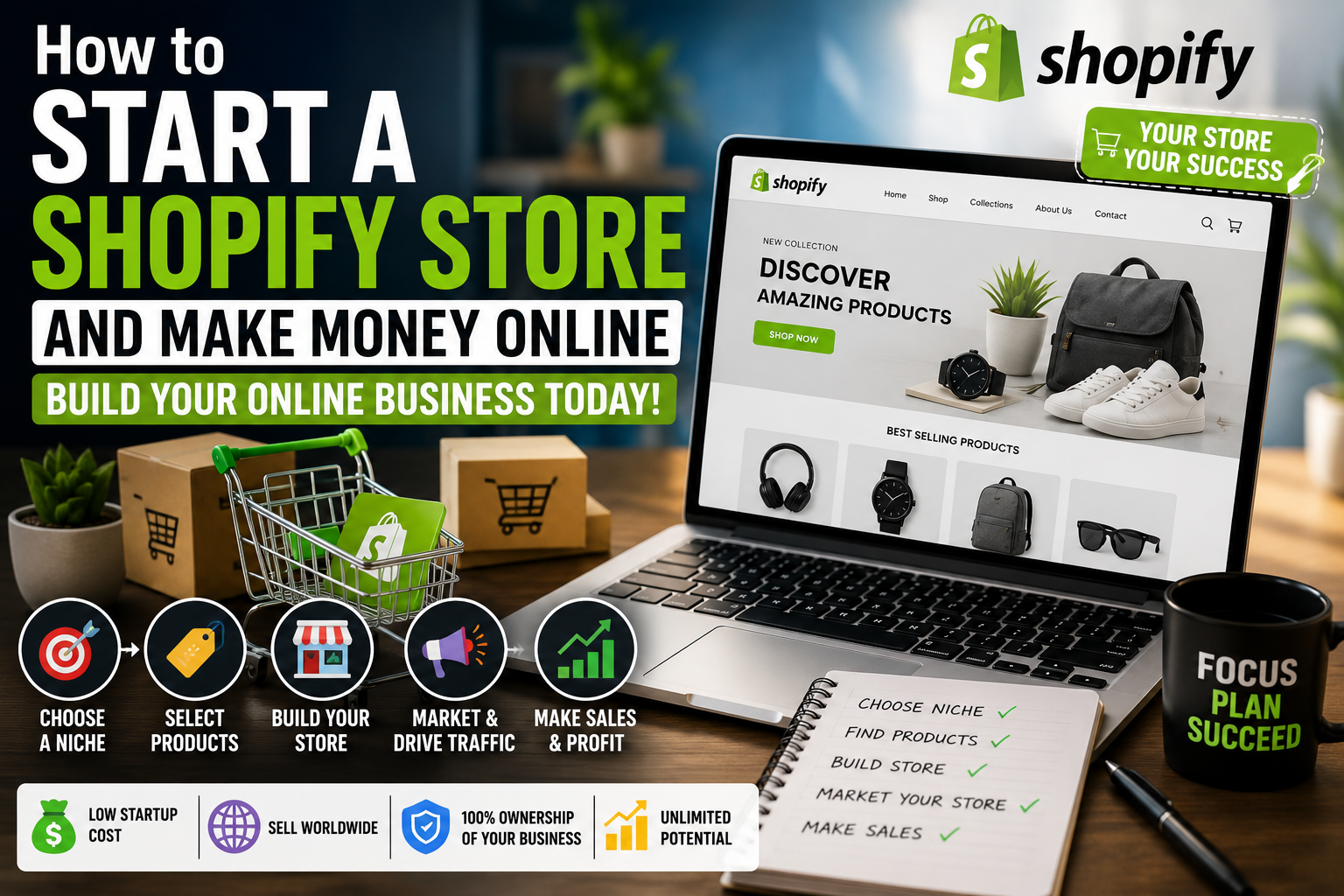
Shopify Store Guide for Beginners: How to Build, Manage, and Improve an Online Store
Starting an online store involves much more than choosing products and publishing a website. A store needs a clear purpose, useful product information, reliable payment and delivery processes, customer support, and a strategy for improving the shopping experience over time.
Shopify is a commerce platform that brings many of these functions together. Store owners can use it to create an online storefront, manage products and inventory, process payments, organize orders, and connect additional sales and marketing tools. Shopify’s available features vary according to the plan, region, and configuration of the store.
For beginners, one of Shopify’s main advantages is that it reduces the amount of technical work required to launch an online store. However, using Shopify does not automatically make a business successful. Product selection, pricing, customer service, fulfillment, website usability, marketing, and ongoing testing still require careful attention.
This guide explains the major areas beginners should understand before and after launching a Shopify store.
What Is Shopify?
Shopify is an eCommerce platform designed to help businesses create and operate online stores. It provides tools for presenting products, managing orders, handling inventory, processing payments, and connecting with different sales channels.
A Shopify store can be customized using themes and additional applications. Businesses can also use Shopify for different selling environments, including online sales and, where supported, in-person commerce.
The platform is useful for different types of businesses, including:
- Physical product stores
- Digital product businesses
- Small retail brands
- Established eCommerce businesses
- Businesses selling through multiple channels
- Brands expanding into international markets
The right setup depends on what a business sells, where its customers are located, its budget, and the operational requirements of the store.
Why Do People Choose Shopify?
Shopify is popular partly because many important eCommerce functions can be managed from a central administration area.
Instead of assembling every part of an online store independently, a store owner can work with Shopify’s storefront tools, product management, checkout, analytics, order management, and available apps.
1. Storefront Customization
Shopify provides themes and an online store editor that allow merchants to create and customize their storefront without building every component from scratch.
A good design should not simply look attractive. It should help visitors understand:
- What the business sells
- Who the products are for
- How much products cost
- How products are delivered
- How customers can contact the business
- What happens if an order needs to be returned
The goal should be clarity rather than unnecessary visual effects.
2. Product and Inventory Management
An online store needs accurate product information and reliable inventory records.
Shopify provides tools for managing products, variants, inventory, orders, and other store information.
For each product, consider providing:
- A clear product name
- Original product images
- Accurate dimensions or specifications
- Available colors or variations
- Materials or ingredients where relevant
- Price and applicable taxes
- Shipping information
- Instructions for use
- Warranty information when applicable
Avoid copying descriptions directly from suppliers. Original descriptions are more useful to customers because they can explain the product in the context of your particular store.
3. Payment and Checkout
A trustworthy checkout process is an important part of an eCommerce website.
Shopify provides payment options that vary according to location and configuration. Merchants should check which payment methods are actually available in their country and suitable for their customers rather than assuming that every payment service is supported everywhere.
Before launching, test the checkout process yourself.
Check whether customers can:
- Add products to their cart.
- Review their order.
- Enter the required information.
- Select an available payment method.
- Understand shipping charges.
- Complete the purchase without unnecessary confusion.
A technically functional checkout is not enough; the process should also be understandable.
Building a Strong Shopify Brand
A brand is more than a logo. It includes the name, visual identity, communication style, product presentation, and overall experience customers associate with a business.
Choose a Clear Store Name
A useful store name should be easy to remember and appropriate for the products or market.
Before using a name, check its availability and investigate whether it could conflict with an existing trademark or business identity.
Create a Consistent Visual Identity
Choose a small set of fonts, colors, imagery styles, and design elements.
Consistency across your:
- Website
- Product packaging
- Social media
- Email communication
- Advertising
- Customer support
can make the business easier to recognize.
Write a Clear Brand Message
Visitors should understand what your business offers without having to search through several pages.
Instead of making vague statements such as “the best products at unbeatable prices,” explain what makes the store useful.
For example:
We provide practical home-organization products selected for small apartments and compact living spaces.
Specific messaging gives visitors more useful information than generic promotional language.
Creating Better Product Pages
Product pages are among the most important pages in an online store.
A useful product page should answer the questions a customer is likely to have before purchasing.
Include:
- Original photographs
- Product specifications
- Size information
- Materials
- Available variations
- Instructions
- Shipping information
- Return conditions
- Frequently asked questions
- Relevant customer reviews where legitimately collected
Do not exaggerate product benefits or make claims that cannot be supported.
For example, if a product is described as waterproof, the store should have reliable information supporting that claim.
Good product content improves both the customer experience and the usefulness of the page for search visitors.
Using Email Marketing Responsibly
Email can be useful for communicating with customers who have voluntarily subscribed.
Possible email content includes:
- Welcome messages
- Product education
- New product announcements
- Useful guides
- Order-related communication
- Seasonal information
- Customer surveys
The objective should not be to send as many promotional messages as possible.
A better approach is to provide information that subscribers actually find useful.
Segmenting Your Audience
Different customers may have different interests.
For example, a clothing store could separate subscribers based on product categories they have shown interest in.
A business might create groups such as:
- New subscribers
- Existing customers
- Customers interested in a particular product category
- Customers who have purchased previously
This can make communication more relevant.
Always follow applicable email marketing, privacy, and consent requirements in the markets where you operate.
Customer Service Matters
Customer service is an important part of eCommerce because customers cannot physically inspect the products before ordering.
A store should make it easy to find:
- Contact information
- Shipping information
- Return and refund policies
- Frequently asked questions
- Order tracking information
- Business details
Responding to Customers
When customers report a problem, focus on understanding the issue before responding.
For example, if an order is delayed, provide accurate information rather than making promises about a delivery date that you cannot control.
A professional support process can include:
- Acknowledge the customer’s message.
- Check the relevant order information.
- Explain what happened.
- Provide realistic options.
- Follow up when necessary.
Customer service should complement the product itself rather than compensate for poor product quality.
Selling Internationally
Shopify provides tools for businesses that want to operate across different markets, including options related to currencies, languages, domains, product catalogs, and market-specific experiences. However, international selling involves more than changing a currency symbol.
Before selling to another country, investigate:
- Shipping costs
- Delivery times
- Import requirements
- Taxes
- Duties
- Payment availability
- Product restrictions
- Consumer protection rules
- Return logistics
- Currency considerations
A store should expand internationally only when its operations can support the additional complexity.
Marketing a Shopify Store
Creating a store does not automatically bring visitors.
A business can use several legitimate marketing channels depending on its audience and resources.
Search Engine Optimization
SEO can help people discover useful product and informational pages through search engines.
Important areas include:
- Descriptive page titles
- Useful product descriptions
- Clear headings
- Logical internal links
- Descriptive URLs
- Fast and mobile-friendly pages
- Helpful educational content
- Original images and media
Avoid filling pages with repeated keywords. Write primarily for people and use relevant terminology naturally.
Content Marketing
A Shopify business can publish educational content related to its products.
For example, a store selling gardening equipment could publish:
- Beginner gardening guides
- Product comparison explanations
- Equipment maintenance advice
- Seasonal gardening information
- Answers to common customer questions
The content should provide information that is genuinely useful rather than existing only to attract search traffic.
Social Media
Social platforms can help businesses demonstrate products, explain how they work, answer questions, and communicate with customers.
Instead of publishing only advertisements, consider creating:
- Demonstration videos
- Tutorials
- Product explanations
- Frequently asked questions
- Behind-the-scenes content
- Customer education
The most appropriate platform depends on the target audience and the type of content being produced.
Measuring Store Performance
Data can help a store owner understand what is working and what needs attention.
Shopify provides analytics for areas such as sales, orders, and online-store visitors, with available reporting depending on the plan.
Useful measurements include:
Traffic
How many people visit the store?
Conversion Rate
What percentage of visitors complete the desired action, such as making a purchase?
Average Order Value
How much does a customer spend per order on average?
Returning Customers
How many customers come back after their first purchase?
Product Performance
Which products receive attention and which products receive little interest?
Customer Feedback
What problems or questions appear repeatedly in reviews, emails, chats, or surveys?
Numbers should be interpreted alongside customer feedback. A metric alone rarely explains why something is happening.
Testing and Improving the Store
A Shopify store should be treated as an evolving project.
Instead of changing many things simultaneously, identify one problem and investigate it.
A simple improvement cycle is:
- Identify a problem.
- Determine a possible cause.
- Make one reasonable change.
- Measure the result.
- Compare the new information with the previous result.
- Keep, modify, or reverse the change.
For example, suppose many visitors view a product page but few add the product to their cart.
Possible explanations could include:
- Unclear product information
- Poor-quality images
- Unexpected shipping costs
- Missing size information
- Slow page performance
- Unclear return policies
- Pricing that does not match customer expectations
Instead of immediately changing the price, investigate these possibilities systematically.
Common Mistakes Beginners Make
Choosing Products Without Research
Personal interest does not necessarily mean there is sufficient demand for a product.
Research the intended audience, competing products, pricing, customer complaints, and fulfillment requirements before investing heavily.
Copying Supplier Descriptions
Copied descriptions provide little additional value and can make product pages look generic.
Rewrite product information based on the actual needs and questions of your customers.
Installing Too Many Apps
Apps can extend Shopify’s functionality, but installing unnecessary applications can increase complexity and costs.
Only install a tool when you understand the problem it solves.
Ignoring Mobile Users
A store that looks good on a desktop computer may still provide a poor smartphone experience.
Test menus, product images, buttons, forms, and checkout on smaller screens.
Making Unsupported Claims
Avoid statements such as:
- “Guaranteed results”
- “Everyone is buying this”
- “Instant success”
- “Risk-free business”
- “Guaranteed profits”
Business performance varies according to products, market conditions, costs, competition, customer demand, and many other factors.
Expecting Immediate Results
A new store may require time to develop its product offering, customer base, search visibility, and operational systems.
Instead of measuring success only by short-term sales, monitor whether the store is improving its products, customer experience, traffic sources, and operational processes.
Building a Sustainable Shopify Store
Long-term store management involves balancing several areas rather than concentrating on marketing alone.
1. Improve the Customer Experience
Make navigation, product discovery, checkout, shipping information, and customer support straightforward.
2. Maintain Product Quality
A strong marketing campaign cannot compensate for consistently poor products.
3. Keep Information Accurate
Update prices, availability, product specifications, shipping times, and policies when circumstances change.
4. Monitor Costs
Store owners should understand expenses such as platform subscriptions, applications, payment processing, advertising, packaging, fulfillment, returns, and taxes.
Revenue is not the same as profit.
5. Build Useful Customer Relationships
Customer communication should provide value rather than consist entirely of sales messages.
6. Continue Learning
eCommerce platforms, consumer behavior, regulations, technology, and marketing practices change over time.
Review your store regularly and update your processes when necessary.
A Practical Shopify Launch Checklist
Before making a store publicly available, review the following:
Store structure
- Is the navigation easy to understand?
- Are important pages accessible?
- Is the homepage clear?
Product information
- Are descriptions original?
- Are specifications accurate?
- Are images clear?
- Are product variations correct?
Customer information
- Are shipping policies visible?
- Are return and refund conditions easy to find?
- Is there a reliable contact method?
Checkout
- Have you tested the purchase process?
- Are available payment methods clearly displayed?
- Are unexpected charges explained?
Mobile experience
- Does the store work properly on smartphones?
- Are buttons easy to use?
- Can customers read product information without excessive zooming?
Performance
- Do pages load efficiently?
- Are unnecessary apps and scripts removed?
- Are images appropriately optimized?
Legal and business requirements
- Are required policies available?
- Are product claims accurate?
- Are applicable tax, privacy, consumer protection, and business requirements being considered?
Shopify and AdSense-Friendly Content: An Important Distinction
If you are writing about Shopify on an information website, the article should provide value beyond simply encouraging readers to create a Shopify account.
Google’s guidance emphasizes unique and relevant content, clear navigation, and original information or commentary. Google also specifically recommends adding your own expertise, ideas, reviews, or other useful material when discussing information from external sources.
Therefore, a high-quality Shopify article should avoid becoming a collection of generic statements such as “Shopify is easy,” “Shopify helps you make money,” or “Shopify is the best platform.”
A stronger article explains why a feature matters, when it is useful, what limitations a beginner should consider, and how the reader can make a sensible decision.
This distinction is particularly important for websites publishing multiple articles about online business. Ten articles that repeat the same advice with different headings may provide less value than one comprehensive guide containing original analysis and practical examples.
Final Thoughts
Shopify can simplify many parts of running an online store, but the platform itself is only one component of an eCommerce business.
A sustainable store depends on the quality of its products, the accuracy of its information, the reliability of fulfillment, the clarity of its policies, the quality of customer service, and the ability to learn from customer behavior.
Beginners should therefore approach Shopify as a business management tool rather than a shortcut to guaranteed results.
Start with a clear product idea, understand the intended customer, create useful product pages, test the purchasing experience, monitor performance, and improve the store based on evidence.
Over time, these practices can create a more useful and trustworthy shopping experience.
Key Takeaway: Shopify provides tools for building and managing an online store, but long-term results depend on how effectively those tools are used. Focus on useful products, accurate information, customer experience, responsible marketing, careful cost management, and continuous improvement rather than promises of quick success.